
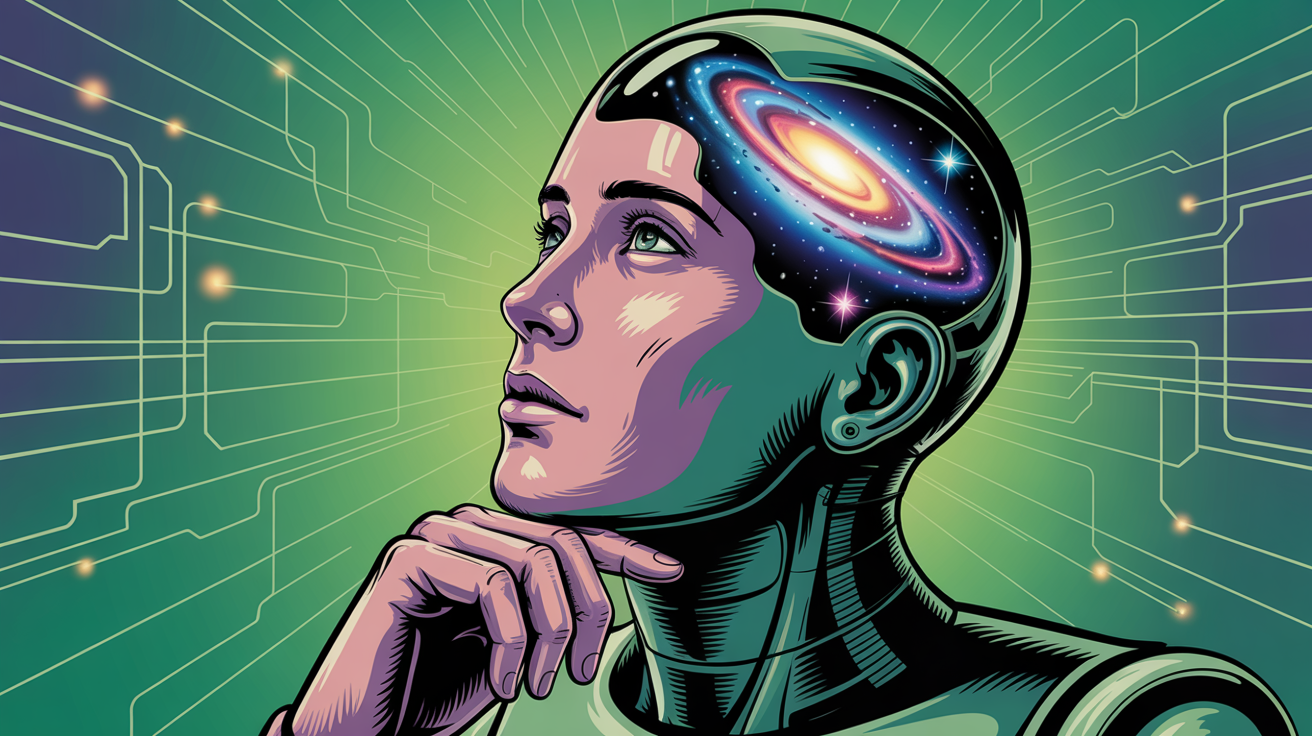
Building More Adaptive AI: How COSMOS Borrows from Consciousness Research
We're excited to announce that our research paper, "Agentic Correlates of Consciousness and The Pursuit of Artificial General Intelligence," has been accepted at AGI-25, the 18th Annual AGI Conference. Led by Gray Sky AI founder Shannon Gray, this work introduces a novel framework for building more adaptive AI systems by drawing insights from consciousness research.
The path toward Artificial General Intelligence (AGI) has largely focused on scaling models and improving training techniques. But what if we're missing something fundamental about how intelligence actually works? Our latest research paper introduces COSMOS (Consciousness-Oriented Self-Modifying Operating System), a framework that takes inspiration from consciousness research to build more adaptive, self-aware AI systems.
The Problem with Static AI Architecture
Today's AI systems, even the most advanced ones, operate with static system prompts and rigid context windows. They process input, generate output, and move on—without true self-reflection or adaptive learning from their interactions. This can work well for specialised tasks but creates significant limitations:
- Context overflow: As conversations grow longer, important information gets pushed out
- Inflexible identity: The system's "personality" remains fixed regardless of context
- Poor error monitoring: While AI can correct errors when told, it struggles to detect its own mistakes
- Limited adaptability: No mechanism for learning and evolving from experience
Learning from biology: key insights from consciousness research
Rather than trying to create consciousness itself, COSMOS implements cognitive functions that consciousness research has identified as likely to be involved in conscious thought:
Metacognition: thinking about thinking
At the core of COSMOS is a second-order LLM that observes and reflects on the primary system's internal processes. This creates a scaffolding for self-awareness—the system can literally think about its own thinking patterns and adjust accordingly.
Perceptual filtering & attention
Just as the human brain filters sensory input to focus on what's relevant, COSMOS implements attention-inspired gating mechanisms. This prevents information overload and helps the system prioritize meaningful context within its computational constraints.
Predictive Processing
The system doesn't just react to inputs—it actively predicts outcomes before taking actions. This dual approach allows for both pre-execution planning and real-time course correction during task execution.
Dynamic self and world models
Perhaps most importantly, COSMOS continuously recreates its understanding of both itself and its environment. The system prompt (Self-Model) and context window (World-Model) are dynamically reconstructed for each cognitive cycle, containing only information relevant to the current task.
The COSMOS architecture: three subsystems working in concert
Executive Planner
Think of this as the system's prefrontal cortex—responsible for high-level reasoning, decision-making, and strategic planning. It analyzes the current self and world models to formulate action plans.
Sensory Interface
This subsystem handles all environmental interactions—tool usage, communication, and action execution. It's the bridge between abstract planning and concrete reality.
Metacognitive Architect
The most novel component, this subsystem functions as both witness and curator. It:
- Processes raw environmental data
- Evaluates outcomes against expectations
- Updates both self and world models based on relevance
- Manages episodic, semantic, and procedural memories
- Selects relevant tools for each task
The Architect-Plan-Interact Loop

The heart of COSMOS lies in its cyclic cognitive loop, where two distinct agentic minds work in tandem. The first-order agentic mind—our Executive Planner—generates action plans to fulfill the current task. These plans are executed by the Sensory Interface, a purely deterministic and reactive system that functions like the motor cortex, sensory apparatus, and musculoskeletal system in humans.
The resulting environmental changes, as observed by the Sensory Interface, are recorded and sent to a second, higher-order agentic mind: the Metacognitive Architect. This creates a sophisticated assessment and adaptation cycle:
Successful task completion
When the Architect's assessment indicates successful task completion, it:
- Examines the next task in the queue
- Constructs a new identity for the Executive Planner specifically designed for the upcoming task
- Builds a fresh world model composed of environmental data and memories relevant to the current objective
- Filters available data to focus the agent's attention only on relevant information, ensuring the Executive Planner's context window remains uncluttered
Task failure and adaptation
If the assessment reveals unsatisfactory completion, the Architect:
- Analyzes the failure to determine if the task definition or agent identity needs modification
- Creates an updated world model that includes data about the failure
- Enables the Executive Planner to formulate a new action plan with this failure information
- Allows the system to attempt the task again with improved understanding
This dual-mind architecture ensures that the system not only executes tasks but continuously evaluates and improves its approach. The Architect simultaneously forms new memories and manages tool selection throughout this process, creating a feedback mechanism that drives genuine learning and adaptation.
Memory that actually works
Traditional LLM memory systems often struggle with relevance and context. COSMOS implements a sophisticated memory architecture inspired by cognitive science:
- Episodic Memory: Personal experiences and behavioral patterns that inform identity
- Semantic Memory: Environmental knowledge stored in vector databases and knowledge graphs
- Procedural Memory: Tools, methods, and their expected outcomes and failure modes
The Architect selectively retrieves and integrates only relevant memories for each task, preventing context pollution while maintaining access to the full knowledge base.
Dynamic tool management
Instead of presenting the system with every available tool, COSMOS implements intelligent tool selection:
- All tools are stored in a vector database
- Only task-relevant tools are made available to the Executive Planner
- This reduces cognitive load and prevents inappropriate tool selection
- Model Context Protocol (MCP) clients are managed alongside internal tools
Goal management with human oversight
COSMOS can handle complex, multi-step goals by:
- Decomposing objectives into hierarchical task structures
- Identifying dependencies between tasks
- Defining clear success criteria for each task
- Monitoring progress and adapting approaches as needed
Importantly, goal setting and modification require human approval, maintaining safety while allowing dynamic execution pathways.
Real-world applications
This architecture has potential applications in:
- Autonomous agents that need to adapt to changing environments
- Long-term assistance systems that evolve with user needs
- Complex problem-solving requiring multi-step reasoning and adaptation
- Interactive AI that maintains coherent identity across varied contexts
The Road Ahead
COSMOS doesn't claim to solve consciousness or create sentient machines. Instead, it demonstrates how insights from consciousness research can inform more reliable, adaptable AI architectures. As we continue development, we're focused on:
- Refining the cognitive cycle for better adaptation
- Expanding memory integration and retrieval mechanisms
- Improving goal decomposition and task management
- Enhancing safety measures and alignment protocols
Conclusion
COSMOS represents a shift from reactive to proactive AI systems. By implementing consciousness-inspired cognitive functions, we're building systems that:
- Adapt their identity to different contexts (professional vs. casual interactions)
- Learn from experience through continuous model updating
- Monitor their own performance and detect potential errors
- Manage complex, multi-step objectives with human oversight
- Efficiently use computational resources through intelligent filtering and selection
Read the full research paper here for detailed technical specifications, implementation details, and comprehensive analysis of the COSMOS framework.
Interested in contributing to this research or exploring applications for your use case? Contact our team to learn more about COSMOS and our ongoing development.
This article is licensed under CC BY-SA 4.0.